In a world where individuals are constantly connected, it can be challenging to detach from work and take time for essential relaxation. How...
In a world where individuals are constantly connected, it can be challenging to detach from work and take time for essential relaxation. However, prioritizing self-care is crucial for enhancing productivity, fostering job satisfaction, and attaining both personal and career success.
It is essential to evaluate your office setting and team to identify which elements greatly affect well-being and efficiency. Developing and implementing improvement plans is a routine task for business owners and employees — you can apply the same method to prioritize self-care and personal health. This guide will demonstrate how to use self-care to enhance productivity at work, explain what self-care entails, why it matters, and how companies can assist employees in their self-care initiatives — for their benefit and to enhance overall company performance.
What does personal care in the office environment entail?
When the phrase "self-care" comes to mind, you might immediately picture spa days and meditation. Although these are a few typical examples of self-care, engaging in self-care goes far beyond these activities. Self-care refers to any action taken to enhance one's physical, mental, or emotional health. Taking it a step further, self-care in the workplace means performing certain actions that promote your well-being, which in turn helps you be more efficient and involved in your job.
Maintaining self-care and mental health is crucial for a successful and productive work environment," stated Dr. Jeffrey Ditzell, a psychiatrist at Dr. Ditzell Psychiatry. "From a medical standpoint, they serve as the base for cognitive abilities, emotional control, and long-term drive.
For instance, if you experience a hectic day at your job, you might prefer to relax with an engaging book in the evening to distract yourself. If your routine involves sitting at your desk throughout the day, self-care could include going for a 30-minute walk outside during your work hours. If you're overwhelmed by tasks, self-care might also involve politely declining to assist with another project. Each person faces different stressors in their work environment, so the type of self-care that works for you may vary from what others find helpful.
What makes self-care essential for maintaining efficiency at work?
Self-care is employed to enhance physical, mental, and emotional well-being, a blend that is crucial for maintaining productivity over an extended period. When neglected,stress can impact productivityhealth and happiness. Stress is also a significant factor in burnout — a problem believed to cost companies between $4,000 and $21,000 each year, as reported in a study published in theAmerican Journal of Preventive Medicine"Promoting a culture of self-care and mental health isn't merely an act of kindness; it's also a wise investment," Ditzell stated.
Here are several ways that stress and self-care influence both physical and mental well-being:
Physical health impact
Stress can impact your body physically, leading to conditions like elevated blood pressure, migraines, digestive problems, chest discomfort, and difficulties sleeping. These health problems may range from minor annoyances to serious issues that result in employees taking time off work, thereby affecting overall productivity.
If an individual is exhausted, their performance or output tends to be slow and lacks the energy required to carry out tasks efficiently," said April Taylor, an entrepreneur and financial advisor. "When someone feels well-rested, they can maximize their efforts and productivity because they are operating from a place of full capacity.
Methods for physical self-care, including routine health check-ups, physical activity, nutritious meals, adequate rest, and stress-reduction practices, can enable employees to maintain good physical health and be prepared for their work.
Effects on mental and emotional well-being
Workplace stressors can result in emotional and mental health challenges, including anxiety, depression, burnout, disconnection, and difficulty concentrating — all of which typically lead to lower productivity in the workplace. Strategies for mental and emotional self-care enable employees and business leaders to hit a reset button and tackle these issues before they begin to affect your organization's finances.
What strategies can I implement through self-care to boost efficiency at work?
Self-care refers to nurturing your physical, emotional, and mental health. To enhance your overall self-care in the workplace, it's essential to focus on all three aspects.
Physical self-care
Here are several methods to adjust your physical space in order to practice self-care:
- Design a cozy and user-friendly work areaEvaluate the conditions at your workplace that can be modified physically to enhance your employees' health. Allocate resources towards high-quality desks (or adjustable standing desks), ergonomic seating, and adequate lighting to minimize physical discomfort.
- Enhance the illumination in your work areaThe kind of lighting in your work area can greatly affect overall well-being and should be taken into account as part of personal self-care. Research has shown that light has a clear effect on office efficiency, mood, energy levels, and alertness. Natural light during the morning and evening hours is most beneficial. Even if daylight isn't accessible, studies have found that using "blue-enriched" light bulbs can enhance job performance by promoting mental sharpness, energy, and alertness, while also decreasing tiredness and daytime drowsiness.
- Promote the application of the 20-20-20 technique:If a job involves spending long hours looking at computer screens, it's wise to maintain good eye health by using the 20-20-20 rule. This guideline suggests that every 20 minutes spent on a screen, you should focus on an object 20 feet away for a minimum of 20 seconds. This practice not only supports eye health but also encourages regular pauses — both beneficial for overall physical wellness. Ditzell mentioned that he frequently advised his patients to use the Pomodoro Technique: "Work for 25 minutes, then take a five-minute break," he explained. "It's quite effective in maintaining energy and concentration throughout the day."
Emotional self-care
You might be a business leader or a staff member, but above all, you are a person — and people experience feelings. You may attempt to hide your emotions in the workplace, but they will probably surface eventually, in some form. Regularly evaluate your emotional condition and how your job is affecting it.
Here are a few suggestions for nurturing your emotional well-being:
- Set professional boundaries: Boundaries can be an effective method for preserving emotional health and increasing efficiency. Ditzell acknowledged that the fast-paced nature of modern life makes it difficult to uphold these limits, but "distinguishing between work and personal time is crucial." For instance, if atoxic co-workercontinually interrupts you with grievances all day, self-care might include establishing clear communication limits with them or working from home on certain days to create some distance.
- Evaluate the distribution of work and risk of exhaustion:Another factor to think about is how the workload is affecting you and your team. Are all individuals feeling overwhelmed and experiencing burnout? Ditzell mentioned that although it might seem efficient, "the research shows that multitasking actually hinders productivity and results in more errors. Even brief interruptions can double the likelihood of mistakes." If the workload becomes too heavy, self-care could involve declining additional tasks when a coworker asks you to take them on.
- Employ traditional self-care techniques:Numerous traditional self-care practices can enhance your emotional health. Examples are journaling, meditation, and counseling. A straightforward self-care routine that individuals can easily add to their daily schedule is staying properly hydrated. As Ditzell notes, dehydration can reduce cognitive performance by 20 percent. His suggestion: "Have a water bottle on your desk."
Mental self-care
Along with evaluating physical and mental health,mental healthis crucial to take into account. Here are some suggestions for maintaining mental well-being:
- Take a day off for your mental well-being:A fine illustration of maintaining mental well-being is taking days off for one's mental health when necessary, aemployee benefitEmployers might provide. It is no longer seen as a sign of pride to work excessively. Individuals should assess their mental state and take time off from work when necessary.
- Activate a timer to schedule brief pauses during the day:It may be beneficial to take short five-minute breaks during the workday. This includes stepping away from work and focusing on mental well-being through activities such as reading, listening to a podcast, or going for a quick walk. Taylor also recommended not missing meals and using that time to "feed your body ... shut your eyes and think about something that brings you joy." This mental pause can be exactly what's needed to keep going with the rest of the day.
- Listen to music: According to Statista, listening to music is the most popular way for young people in the United States to take care of themselves. Hearing the appropriate music can raise dopamine levels and enhance general happiness and efficiency.
What strategies can company executives employ to enhance work efficiency through personal well-being?
Self-care holds particular significance for business leaders, as they establish the atmosphere for the entire organization. Below are several essential guidelines that business owners and managers should consider while managing self-care for both themselves and their teams:
- Focus on your personal well-being:The actions of leaders greatly influence the people they guide, and it will be challenging for you to encourage others to prioritize self-care if you are not doing so yourself. "Mental health is like the operating system of a computer," Ditzell explained. "No matter how advanced the software is, if the system has issues, performance declines."
- Talk it over with your team:Viewing elevated stress as a standard part of business operations can harm your overall goals. A more effective method is to openly address workplace stressors with a planned and thoughtful approach, allowing team members to collaborate on finding resolutions. "Individuals desire to feel that they are more than just an employee number, but rather valued," Taylor explained. "Simply expressing that employers care about employees' happiness and well-being encourages individuals to place self-care at the forefront of their priorities."
- Increase autonomy:Jobs that require intense demands and tight deadlines can greatly increase employee stress, particularly if workers have minimal control over how they carry out their assignments and responsibilities. Whenever feasible, implement changes that promote greater personal independence and a collaborative team environment.
- Reward best efforts:Ongoing labor without recognition can certainly deter self-care and result inemployee burnoutand poor health. "When you take the time to truly disconnect, you are less prone to burnout and more concentrated when you are working," Ditzell stated. Make sure that leaders and their employees are in agreement aboutprofessional developmentand the route to advancement. Back these initiatives with a well-defined and steady system of incentives.
- Increase social support:Social support, which involves active communication, care, and empathy, is essential both inside and outside the workplace. Encourage staff to take breaks to connect with loved ones and provide resources like mentors within the company. Taylor suggested that employers should not only promote taking time off but also make it easy for employees to request such days.
How can I assess the outcomes of self-care practices?
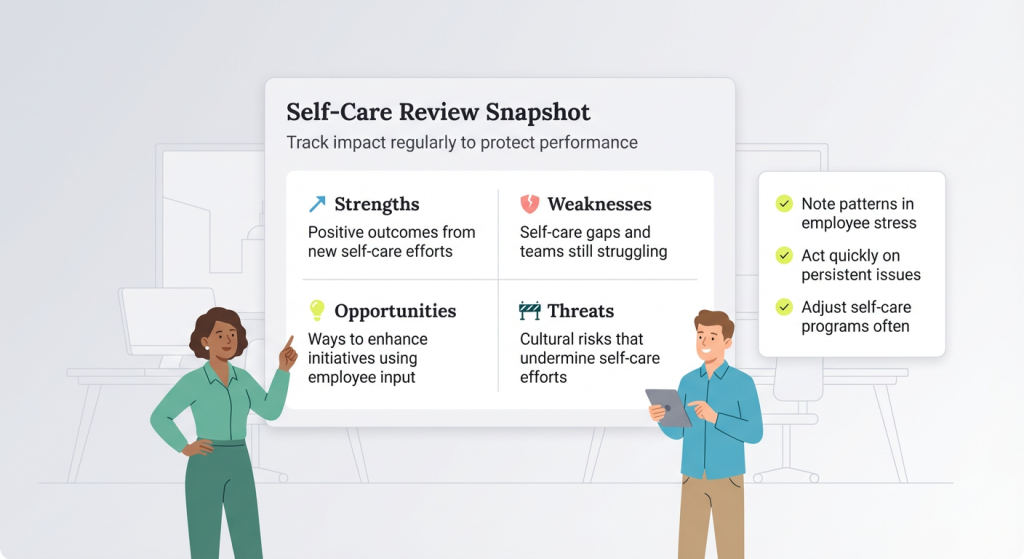
There are several ways to assess self-care outcomes; one is the well-known SWOT analysis, which stands for strengths, weaknesses, opportunities, and threats, or (SWOT) analysis. While commonly used for strategic business planning, a SWOT analysis can also be utilized in evaluating your organization's self-care initiatives:
- Strengths: What beneficial results have emerged from recent self-care initiatives? What approaches are proving most effective?
- Weaknesses: What actions appear to not be working? Are there particular team members who are still having difficulty?
- Opportunities:Where might self-care programs be improved? Have employees been consulted for their opinions?
- Threats:Does anything (or anyone) within the organizational culture consistently hinder self-care initiatives? Are these challenges being handled?
Taylor recommended that leaders pay attention to the results of the SWOT analysis and other signals from their employees showing they are facing challenges because of insufficient self-care. "These signals are clear signs that a fire hose is required — self-care is absent," she mentioned. "Address it early, offer support, and have difficult discussions. Be the 'hero,' rescue the situation, or, in this case, preserve the workplace atmosphere."
Prioritizing personal well-being in the workplace benefits not only your health and that of your colleagues, but also enhances efficiency and contributes to the company's financial success. This creates a positive outcome for all parties involved.
Nicole Fallon and Sue Montgomery were involved in the reporting and authoring of this article.


